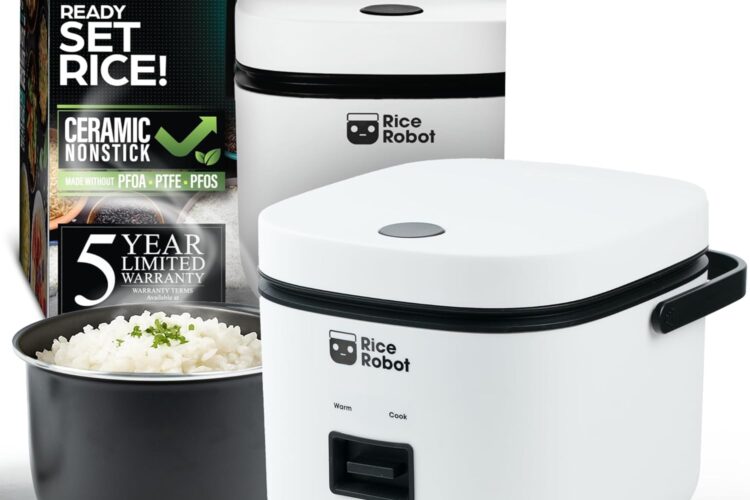
There’s a quiet revolution happening in small kitchens everywhere. As more people live alone, embrace meal prepping for one, or simply want a dedicated appliance that handles a single task well, the personal rice cooker has earned a permanent spot on countless countertops. Among the options available today, the Rice Robot Personal Rice Cooker has caught the attention of home cooks who care not only about convenience but also about what materials are touching their food.
This appliance checks a number of boxes that modern consumers are actively looking for: a compact footprint, PFAS-free nonstick construction, a built-in steam tray, and an approachable recipe book to help anyone get started. It’s appeared on television as part of the “As Seen On TV” lineup, which tends to generate curiosity — but beyond the marketing, there’s a genuinely functional kitchen tool worth understanding in depth.
Whether you’re a college student, a minimalist home cook, a busy professional, or someone managing a small household, this guide breaks down everything you’d want to know about the Rice Robot before deciding if it belongs in your kitchen.
What Is the Rice Robot Personal Rice Cooker?
At its core, the Rice Robot is a compact, countertop rice cooker with a 1-quart (approximately 1-liter) capacity — a size designed specifically for individuals or couples rather than large families. It’s built with a nonstick inner pot that is explicitly free from PFAS (per- and polyfluoroalkyl substances), a category of synthetic chemicals that have drawn increasing scrutiny from health-conscious consumers and regulatory bodies alike.
The appliance is designed to go beyond just rice. It includes a stainless steel steamer tray, which allows users to cook vegetables, dumplings, fish, or other foods simultaneously — a thoughtful addition that expands the cooker’s utility without adding bulk. The package also includes measuring cups, a serving spoon, and a 60-recipe booklet that covers a range of dishes far beyond plain white rice.
Key Features Worth Understanding
PFAS-Free Nonstick Coating
This is arguably the most talked-about aspect of the Rice Robot, and for good reason. PFAS — sometimes called “forever chemicals” — are used in many traditional nonstick coatings. Growing research into their persistence in the environment and the human body has led many consumers to seek out PFAS-free cookware. The Rice Robot’s inner cooking pot addresses this concern directly, offering a nonstick surface without the chemicals that have raised health and environmental questions.
It’s worth understanding that “PFAS-free nonstick” doesn’t mean the pot has no coating at all — it means the coating is formulated without PFAS compounds. This is a meaningful distinction for anyone who regularly cooks in nonstick vessels and wants to minimize chemical exposure.
1-Quart Capacity
Compact is the operative word here. The 1-quart capacity is well-suited for cooking one to two servings of rice or grains at a time, making it ideal for individuals who don’t want to deal with leftovers piling up or the inefficiency of running a large cooker for a single portion.
That said, it’s important to be realistic about what this size means in practice. If you’re regularly cooking for three or more people, you may find yourself running the appliance multiple times per meal — which could affect both time and energy efficiency. For solo cooking, though, this size tends to hit a sweet spot.
Stainless Steel Steamer Tray
Steamer trays made from stainless steel are considered a cleaner option compared to plastic steaming baskets, especially when exposed to consistent heat. The inclusion of a stainless steel tray here allows for simultaneous cooking: rice or grains on the bottom, vegetables or proteins steaming above. This approach can save meaningful time in meal prep and reduces the number of pots needed for a complete meal.
60-Recipe Booklet
A recipe book might seem like a minor addition, but 60 recipes represent a genuine attempt to help users see this appliance as more than a one-trick tool. The recipes reportedly go beyond rice to include dishes like quinoa bowls, oatmeal, soups, steamed fish, and more — each scaled to the compact capacity of the cooker. For someone new to rice cookers or looking for fresh ideas, this can serve as a useful starting point.
Measuring Cups and Serving Spoon
These inclusions eliminate the need to scrounge for matching tools. The measuring cups are calibrated for the cooker’s capacity, which helps avoid the common mistake of overfilling — something that can affect cooking performance and create a mess. The serving spoon is designed to work with the nonstick surface without scratching it.
How the Rice Robot Can Be Used
Everyday Rice and Grains
The obvious starting point is plain rice — white rice, brown rice, jasmine, basmati, or short-grain. Most rice cookers handle these with a simple set-and-forget method: add the grain, add water according to the ratio, press start, and wait. The Rice Robot follows this same logic, making it accessible even for people who’ve never owned a dedicated rice cooker.
Beyond rice, the cooker can handle other whole grains like quinoa, farro, millet, and bulgur. These grains are increasingly popular as dietary staples and cook beautifully in a rice cooker environment where heat and steam are controlled consistently.
Steamed Vegetables and Proteins
With the stainless steel tray in place, the cooker doubles as a steamer. Broccoli, carrots, green beans, and leafy vegetables can all be steamed over the cooking rice. Fish fillets, shrimp, dumplings, and tofu are other popular choices for the steamer basket. The end result is a complete, balanced meal cooked in a single appliance — an appealing proposition for anyone short on time or counter space.
Soups and Porridges
The 1-quart capacity is well-sized for a single portion of congee (rice porridge), oatmeal, or a small batch of vegetable soup. These are dishes that benefit from low, consistent heat — exactly what a compact rice cooker delivers. Many rice cookers can maintain a warm temperature after cooking, which is useful for porridge-style dishes that benefit from a longer, slower simmer.
Meal Prepping for One
Solo meal preppers often cite the challenge of scaling recipes down to appropriate quantities. The Rice Robot is well-suited for this scenario. Rather than cooking a full pot of grains and watching half of it go stale, you can make exactly what you need, when you need it, with minimal cleanup.
Who Might Find This Appliance Useful
Solo Dwellers and Students
Individuals living alone — particularly college students or young professionals in smaller apartments — represent perhaps the most natural audience for a 1-quart rice cooker. The compact size won’t overpower a tiny kitchen, the operation is simple enough for someone with limited cooking experience, and the output is precisely sized for a single meal.
Health-Conscious Cooks
Anyone who has spent time reading about PFAS and nonstick cookware will appreciate the explicit PFAS-free claim. Combined with the stainless steel steamer tray, this cooker aligns well with a kitchen philosophy that prioritizes cleaner materials. It’s also a tool that encourages home cooking over takeout — a choice that typically supports better nutrition.
Small Households
Couples or small households where one person is cooking for themselves regularly could get meaningful use out of this appliance. It doesn’t replace a larger rice cooker if you regularly cook for four or five people, but as a secondary tool or a personal cooker, it earns its place.
Office Kitchens and Break Rooms
The compact size and simple operation make the Rice Robot a surprisingly good fit for a shared office kitchen. Someone could prepare a quick grain bowl or steamed lunch during a workday without taking up much space or generating extensive cleanup.
Travelers and RV Dwellers
For those who travel in recreational vehicles or live in compact mobile setups, small appliances that pull double or triple duty are particularly valuable. A cooker that handles grains, steaming, and porridge in a small footprint can be a meaningful addition to a mobile kitchen.
Important Things to Consider Before Purchasing
Capacity Limitations
A 1-quart cooker is genuinely small. If your household regularly prepares rice for more than two people, or if you like to batch cook for the week ahead, this size may require multiple cooking cycles. It’s worth honestly assessing your typical serving needs before choosing this over a larger model.
Nonstick Care
All nonstick surfaces require some mindfulness in care and use. Metal utensils should generally be avoided in favor of silicone, wood, or plastic tools to preserve the coating over time. The serving spoon included in the package is presumably selected with this in mind. Handwashing nonstick components (rather than running them through a dishwasher) also tends to extend their lifespan significantly.
Electric Power Requirements
Like all electric appliances, the Rice Robot requires access to a standard outlet. For travelers or those using it in locations with limited power access, this is worth factoring in. It’s also worth noting that in spaces with limited outlet availability — like a dorm room — a rice cooker competes with other essential electronics for power.
Cooking Times for Different Grains
White rice typically cooks faster than brown rice or denser whole grains like farro or wheat berries. If you plan to regularly cook a variety of grains, expect some variation in cooking times. The included recipe book likely addresses this, but it’s worth setting expectations that not everything will be done in the same 20-minute window.
Stovetop vs. Dedicated Rice Cooker
Some home cooks wonder whether a rice cooker is worth the counter space compared to simply cooking rice on the stovetop. The honest answer depends on personal cooking habits. A rice cooker offers consistency, a hands-off approach, and the ability to walk away without monitoring — benefits that are real but not universally essential. If you already cook rice confidently on the stovetop and have no space concerns, the appliance may be redundant. If rice or grains are a regular fixture in your diet and countertop real estate isn’t an issue, the convenience is genuine.
Personal Rice Cookers vs. Other Cooking Methods: A General Comparison
Personal Rice Cooker vs. Standard Rice Cooker
The primary difference is capacity and size. Standard rice cookers typically offer 3-cup to 10-cup capacity (in cooked rice terms), making them better suited for families or batch cooking. Personal rice cookers sacrifice that volume in exchange for a smaller footprint, faster heating of smaller quantities, and portability. Neither is objectively better — they serve different contexts.
Personal Rice Cooker vs. Instant Pot or Multi-Cooker
Pressure cookers and multi-cookers like the Instant Pot can certainly cook rice, but they’re more complex appliances with steeper learning curves and larger footprints. A personal rice cooker is more focused and simpler in operation — ideal for someone who wants to cook rice and steam food without navigating a multi-function device with dozens of settings. That said, if you already own a multi-cooker, adding a dedicated rice cooker of any size may be redundant.
Personal Rice Cooker vs. Stovetop Method
Cooking rice on the stovetop is accessible and requires no additional appliance. However, it demands more attention — the right heat level, the right timing, and avoiding the pot boiling over. A rice cooker automates this entirely, which is particularly valuable for beginners or for moments when you’re juggling multiple tasks in the kitchen. The stovetop also doesn’t offer steam-cooking capability in the same integrated way.
Personal Rice Cooker vs. Microwave Rice Containers
Microwave rice containers are inexpensive and use no counter space, but they produce less consistent results, can’t steam food simultaneously, and don’t come with the material transparency that a well-labeled PFAS-free appliance provides. For occasional use, they’re convenient; for daily use, a dedicated cooker generally delivers better results.
Frequently Asked Questions
Can the Rice Robot cook brown rice? Most personal rice cookers, including those with similar specifications, can handle brown rice — though brown rice typically requires more water and a longer cooking time than white rice. The included recipe book likely includes guidance on this.
Is the inner pot dishwasher-safe? Nonstick pots generally benefit from handwashing to preserve the coating. Check the specific care instructions included with the product, but as a general rule, handwashing nonstick components extends their useful life.
What foods can I steam in the stainless steel tray? Common options include broccoli, carrots, zucchini, spinach, snap peas, fish fillets, shrimp, chicken strips, dumplings, and eggs. The tray sits above the cooking rice, so both components cook simultaneously.
How long does it take to cook rice? White rice in a compact rice cooker generally takes between 15 and 25 minutes depending on the amount and variety. Brown rice and denser grains take longer — typically 40 to 50 minutes. Cooking times may vary slightly depending on the specific model and settings.
Is this suitable for someone with no cooking experience? Yes. Rice cookers are specifically designed to remove guesswork from grain cooking. Add grain, add water according to the ratio, press the button. The 60-recipe booklet also provides a structured starting point for experimenting beyond basic rice.
What does “PFAS-free” actually mean? PFAS stands for per- and polyfluoroalkyl substances — a large class of synthetic chemicals used in many industrial and consumer products, including traditional nonstick coatings like PTFE (Teflon). “PFAS-free” means the nonstick surface is formulated without these compounds. This doesn’t mean the pot is uncoated — it means the coating uses alternative chemistry that doesn’t contain PFAS.
Can I use it to make oatmeal or porridge? Yes. Oatmeal and congee (rice porridge) are well-suited to rice cookers, which maintain low, consistent heat. These are likely included among the 60 recipes in the included booklet.
Does it have a keep-warm function? Many rice cookers automatically switch to a warm setting after cooking is complete. Whether the Rice Robot includes this feature specifically is worth confirming in the product details — but it’s a common inclusion in appliances of this type.
Conclusion
The Rice Robot Personal Rice Cooker positions itself as a practical, health-conscious choice for anyone who wants the simplicity of a dedicated rice cooker without the bulk, and without the material concerns that come with conventional nonstick coatings. Its 1-quart capacity keeps it firmly in personal-use territory, making it a natural fit for students, solo cooks, small households, and anyone who values a cleaner kitchen toolkit.
The stainless steel steamer tray elevates it from a single-purpose appliance to a genuine mini meal-prep station. The included recipe book, measuring tools, and serving spoon suggest that the product is designed for people who may be new to this style of cooking — or who simply appreciate having everything they need in one package.
As with any kitchen appliance, the right fit depends on your household size, cooking habits, and priorities. But for those it suits, the Rice Robot offers a thoughtful combination of convenience, material transparency, and versatility that goes well beyond a standard single-serve cooker