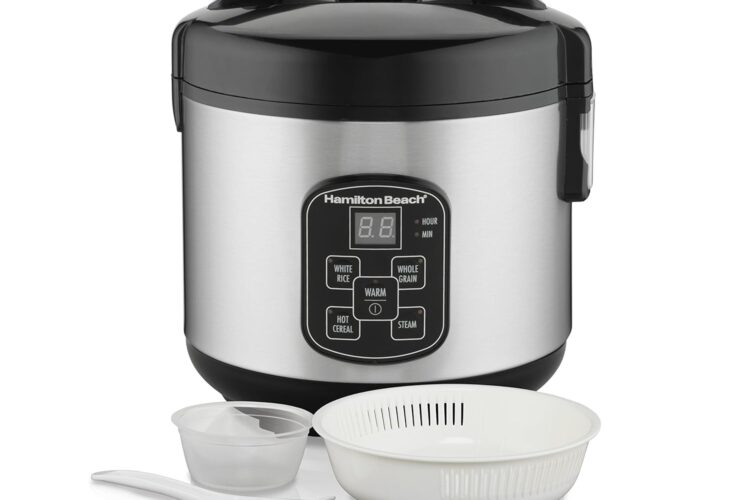
Rice is one of the most widely eaten foods on the planet, and yet cooking it consistently — fluffy every time, no scorched bottom, no soggy texture — is something many home cooks still find slightly nerve-wracking on the stovetop. A dedicated rice cooker removes that uncertainty entirely, and the Hamilton Beach Digital Programmable Rice Cooker & Food Steamer is one of the more practical mid-capacity options available today.
This particular model sits in an interesting category: large enough for family meals, yet not so oversized that it dominates a modest kitchen. Its 8-cup cooked capacity, digital controls, and built-in steaming functionality make it a multi-purpose appliance rather than a single-use gadget. Whether you’re feeding a household of four on a weeknight or preparing grain-based meal preps for the week ahead, it’s the kind of machine that earns its counter space through consistent, quiet utility.
This guide covers everything a potential buyer or curious cook would want to know — features, practical uses, who it suits best, honest considerations, and answers to common questions.
Key Features
Digital Programmable Controls
Unlike older rice cookers that rely on a single on/off switch, this Hamilton Beach model includes a digital control panel with programmable settings. This means you can select from multiple cooking modes depending on what you’re preparing — options typically include white rice, brown rice, and a steam function. The digital interface also tends to offer a delayed start or timer feature on models in this category, allowing you to set the cooker in advance so rice is ready when you arrive home or wake up in the morning.
For people who find analog appliances frustrating or imprecise, a digital display brings a small but meaningful improvement in clarity. You can see exactly what mode is active and, in many cases, how much time remains in the cooking cycle.
8-Cup Cooked Capacity
Capacity in rice cookers is commonly listed in two ways: uncooked or cooked cups. This model specifies 8 cups cooked, which translates to roughly 4 cups of uncooked rice — enough to serve approximately four to six people comfortably, depending on serving size and what else is on the table.
This is a family-friendly capacity without crossing into commercial territory. It’s large enough that you won’t need to run the cooker twice for a dinner of four, but compact enough to fit in a standard kitchen cabinet when not in use.
Food Steaming Function
The inclusion of a steaming basket extends this appliance well beyond its rice-cooking role. The steam function allows you to cook vegetables, seafood, dumplings, and other foods using the steam produced during the cooking process. In practice, this means you can prepare a complete meal — grains below, vegetables or protein above — in a single appliance with a single cleanup.
Steaming as a cooking method is widely regarded as one of the gentler techniques for preserving nutrients in vegetables, particularly water-soluble vitamins that can leach out during boiling. The convenience of doing this in the same pot as your rice is a genuine time-saver on busy evenings.
Keep Warm Function
A keep-warm setting is a standard but genuinely useful feature on rice cookers of this type. Once the cooking cycle completes, the appliance automatically drops to a lower temperature to hold the rice at serving temperature without continuing to cook it. This is especially helpful when meals don’t happen on a fixed schedule — the rice stays ready without drying out or overcooking for a reasonable window of time.
Delay Start / Timer
One of the more convenient features found in programmable rice cookers is the ability to set a delayed start. Rather than needing to be present when the cooking begins, you can load the cooker in the morning and program it to begin cooking in the afternoon so dinner is ready when you need it. For households with predictable routines, this is a surprisingly practical addition.
Removable, Nonstick Inner Pot
The interior cooking pot is designed with a nonstick surface, which simplifies both cooking and cleanup. Rice has a tendency to stick, particularly as it cools or if the water ratio is slightly off. A nonstick pot reduces this problem and makes washing up a quicker process. The pot is also removable, which means cleaning doesn’t require working around the electrical components of the base.
How It Can Be Used
Everyday White and Brown Rice
The foundational use case. White rice, jasmine, basmati, short-grain sushi rice — all of these cook reliably in a dedicated rice cooker with minimal input. Brown rice, which requires more water and a longer cooking time than white varieties, benefits particularly from a programmable cooker that can be set to the correct mode rather than relying on the cook to adjust timing manually.
Whole Grains and Legumes
The cooking environment inside a rice cooker — sealed, steamy, consistent heat — works well for other grains beyond rice. Quinoa, millet, farro, barley, and oat groats can all be prepared this way. Some legumes, particularly lentils, also work well in rice cookers, though larger dried beans generally need to be pre-soaked and may require longer cooking than the appliance is calibrated for.
Steamed Vegetables
With the steaming basket in place, broccoli, cauliflower, green beans, carrots, zucchini, and leafy greens can all be cooked above the rice simultaneously. This approach is particularly useful for weeknight meal prep where efficiency matters. Rather than managing two pots on the stovetop, everything comes together in one appliance.
Steamed Fish and Seafood
Fish fillets and shellfish steam beautifully — the gentle, moist heat prevents them from drying out the way high-heat methods sometimes can. Placing a piece of salmon or a few shrimp in the steaming basket over cooking rice produces a complete, low-effort meal that’s both practical and relatively nutritious.
Oatmeal and Porridge
Overnight oatmeal or congee (rice porridge) are well-suited to a programmable rice cooker, particularly one with a delay start feature. You can load steel-cut oats or rice with liquid the night before, set a timer, and wake up to a hot breakfast without any morning effort beyond pressing a button.
Soups and One-Pot Meals
While this appliance isn’t a pressure cooker, the inner pot’s capacity and consistent low heat make it workable for simple soups, dal, and stew-style dishes. This falls outside the primary design intent, so results may vary, but many home cooks find their rice cookers useful for this kind of flexible, low-supervision cooking.
Who This Appliance May Be Suitable For
Families and Multi-Person Households
The 8-cup cooked capacity is calibrated for households where multiple people eat together regularly. If you’re cooking for three to six people most evenings, this size makes practical sense — you’ll rarely need to run the cooker twice, and leftovers are manageable rather than excessive.
Meal Preppers
Anyone who prepares meals in advance for the week ahead will appreciate the combination of capacity and steaming ability. You can cook a full batch of grains and a round of steamed vegetables in one session, portioning everything out for lunches or dinners later in the week.
Home Cooks New to Grain Cooking
Rice cookers are often recommended to beginners precisely because they remove the variables that make stovetop rice tricky — the right heat level, knowing when to reduce, resisting the urge to lift the lid. A programmable cooker with labeled settings simplifies all of this. The delay start feature also reduces the mental overhead of timing dinner.
Busy Households
For households where evenings are packed with work, childcare, or other obligations, the ability to load the cooker in the morning and have it ready by dinner is a practical benefit. Programmable appliances in general tend to suit busy routines, and the keep-warm function provides additional buffer when meals run late.
Households That Cook a Variety of Grains
If your diet includes a rotation of rice, quinoa, oatmeal, and other grains, having a dedicated appliance that handles all of them without requiring constant supervision is a meaningful convenience. Swapping between settings for different grains is much simpler than manually adjusting stovetop heat and timing for each variety.
Important Things to Consider
Counter and Cabinet Space
At 8-cup cooked capacity, this is a reasonably sized appliance. Before purchasing, it’s worth measuring your available counter or cabinet space and comparing it to the appliance’s dimensions. For small apartments or kitchens with limited storage, a compact personal cooker might be more practical.
Nonstick Maintenance
The nonstick interior pot benefits from gentle care. Metal utensils can scratch the coating over time, so wooden or silicone tools are preferable for scooping and serving. Handwashing the inner pot, rather than running it through a dishwasher, typically extends the coating’s lifespan — though this varies by model and usage frequency.
Cooking Times for Different Grains
White rice generally cooks in 25 to 35 minutes in an electric rice cooker. Brown rice takes considerably longer — often 45 to 55 minutes or more. Denser grains like farro or wheat berries may require even longer cycles, and not all settings are calibrated for every variety. It’s worth reading through the included instructions to understand which settings correspond to which foods.
Capacity Versus Actual Use
An 8-cup cooked capacity is generous, but if you primarily cook for one or two people, you may find yourself underutilizing the appliance — or cooking large batches and managing more leftovers than you intended. Smaller households might genuinely be better served by a 3- or 5-cup model. Matching capacity to actual cooking habits is worth thinking through before purchasing any rice cooker.
Not a Pressure Cooker
It’s worth clarifying what this appliance is not. Unlike an Instant Pot or similar multi-cooker, a standard rice cooker doesn’t use pressure cooking. This means it won’t dramatically speed up the cooking of harder grains or dried beans the way a pressure cooker does. For those use cases, a multi-cooker might be a better fit.
How Rice Cookers Compare to Other Cooking Approaches
Rice Cooker vs. Stovetop
Stovetop rice cooking requires active attention — monitoring heat levels, watching for boiling, knowing when to reduce and cover, and timing the rest period. Rice cookers handle all of these variables automatically. The tradeoff is counter space and an additional appliance to clean. For people who cook rice regularly, the consistency and hands-off nature of a rice cooker tends to outweigh the minor inconvenience.
Rice Cooker vs. Multi-Cooker (Instant Pot, etc.)
Multi-cookers offer a broader range of functions — pressure cooking, slow cooking, sautéing, and often rice cooking modes as well. If kitchen storage is limited and you want a single appliance that does many things, a multi-cooker has a clear advantage. However, multi-cookers are generally more expensive, larger, heavier, and more complex to operate. A dedicated rice cooker like this Hamilton Beach model is simpler, quieter, and typically produces more consistent results specifically for rice and grains.
Rice Cooker vs. Microwave Methods
Microwave rice cookers — lidded containers designed for microwave use — are inexpensive and storage-friendly, but they produce less consistent results and don’t offer steaming capability or keep-warm functionality. For occasional use, they’re sufficient; for households that eat rice several times a week, a dedicated electric cooker provides noticeably better results.
Basic Rice Cooker vs. Programmable Rice Cooker
Even within the category of dedicated rice cookers, there’s variation. Basic models have a single cook/warm switch and no digital interface. Programmable models like this one allow selection between grain types, delayed starts, and specific cooking modes. For cooks who prepare a variety of grains or want the flexibility of timed cooking, the programmable format offers genuine added value rather than just added complexity.
Frequently Asked Questions
How many people will 8 cups of cooked rice serve? Roughly four to six people as a side dish, or three to four people as a primary carbohydrate component of a meal. Serving size varies depending on appetite and what else is being served.
Can it cook brown rice? Yes. Most programmable rice cookers, including models in this category, include a specific setting for brown rice, which requires more water and a longer cooking time than white rice. Using the dedicated brown rice setting rather than the standard white rice mode typically produces better results.
Is the inner pot dishwasher-safe? Many nonstick inner pots in this category are labeled dishwasher-safe, but handwashing is generally recommended to preserve the coating over time. Check the specific care instructions included with the product for guidance.
Can I cook pasta or noodles in it? Rice cookers are not generally designed for pasta, which requires boiling in a larger volume of water than grain cooking uses. The results tend to be uneven and the cleanup more difficult. Pasta is better prepared on the stovetop.
What happens if I’m not home when it finishes cooking? The keep-warm function activates automatically once the cooking cycle ends, holding the rice at a safe serving temperature. This provides a reasonable window — typically several hours — during which the rice remains suitable for eating without becoming dried out or overcooked.
Does the delay start feature work with the steaming basket as well? Delay start functions are primarily designed for grain cooking. Using raw proteins in a steaming basket during a delayed start raises food safety concerns, as the food would sit at room temperature before cooking begins. Vegetables are generally safer for this use case. When in doubt, refer to the manufacturer’s instructions.
How do I clean the steaming basket? Steaming baskets in rice cookers are typically removable and washable in warm soapy water. Many are dishwasher-safe. Check the product documentation for specific guidance.
Can I use it to make risotto? Risotto is traditionally prepared through a continuous stirring process that builds starch gradually — a method that doesn’t translate well to a sealed rice cooker. While some cooks have experimented with simplified rice-cooker risotto, the results differ from the traditional preparation. It’s a creative use, but not one the appliance is specifically designed for.
Conclusion
The Hamilton Beach Digital Programmable Rice Cooker & Food Steamer offers a practical, well-rounded solution for households that eat rice and grains regularly. Its 8-cup cooked capacity suits families and meal preppers; the digital programming removes the guesswork from multi-grain cooking; and the steaming function extends its usefulness into full meal territory. The keep-warm and delay-start features add a layer of convenience that genuinely fits into busy daily routines.
As with any kitchen appliance, it’s not for everyone. Small households may find the capacity more than they need, and those already invested in a multi-cooker may find the overlap too significant to justify. But for its intended audience — households that want consistent, hands-off grain cooking with the added bonus of a steamer — it delivers a focused, dependable performance.