Rice cooking is one of those kitchen tasks that seems simple on the surface but can be surprisingly difficult to master. Anyone who has attempted to cook rice on the stovetop knows the struggle: too much water results in mushy rice, too little leaves you with crunchy grains, and timing issues mean you either undercook or overcook the batch. For decades, cooks have sought reliable methods to achieve consistently fluffy, well-prepared rice without constant monitoring and adjustment.
The emergence of dedicated rice cookers transformed how many households approach this staple grain. Rather than wrestling with pot lids and stove temperatures, modern rice cookers use automated technology to manage heat, moisture, and timing. Among the various brands and models available, Zojirushi stands out as a manufacturer known for investing in sophisticated cooking technology. The NS-ZCC10 represents a particular approach to rice cooking that combines accessibility with features designed to handle different rice varieties and textures.
This article explores what the NS-ZCC10 offers, how it operates, who might find it useful, and what practical considerations matter when choosing a rice cooker for your kitchen. Whether you cook rice regularly or occasionally, understanding how different models approach the cooking process helps inform better decisions about kitchen tools.
Key Features and Technology
Neuro Fuzzy Programming Explained
At the heart of the NS-ZCC10 sits its neuro fuzzy technology. This term, while somewhat technical-sounding, refers to a system that uses sensors and microprocessor logic to monitor and adjust cooking conditions in real time. Rather than following a rigid heating schedule, neuro fuzzy systems measure factors like steam pressure, temperature, and moisture levels throughout the cooking cycle, then make adjustments as needed.
Think of it like having an experienced cook standing at your stove, monitoring conditions and making small adjustments. If the cooker detects that moisture is evaporating faster than expected, it might adjust the heat slightly lower. If it senses that the rice hasn’t absorbed enough liquid by a certain point, the heating duration might extend. This adaptive approach theoretically reduces the variation in results that can occur with simpler, one-temperature-fits-all cooking methods.
For practical purposes, this means that the NS-ZCC10 can handle variations in rice quality, water content in grains, and even elevation differences without requiring manual intervention or constant attention from the cook.
Capacity and Physical Design
The NS-ZCC10 has a 5.5-cup capacity (typically measured in uncooked rice). This size range fits comfortably in the middle ground—large enough to feed a family-sized portion or prepare rice for meal planning, yet compact enough to fit on most kitchen counters or in cabinets without excessive space demands.
The inner cooking vessel uses a nonstick-coated removable pan, which affects both cooking performance and maintenance. Nonstick surfaces distribute heat more evenly than bare metal and simplify cleanup. The removable design means you can take the cooking vessel out for washing separately from the main cooker body, making the entire appliance more practical for regular use.
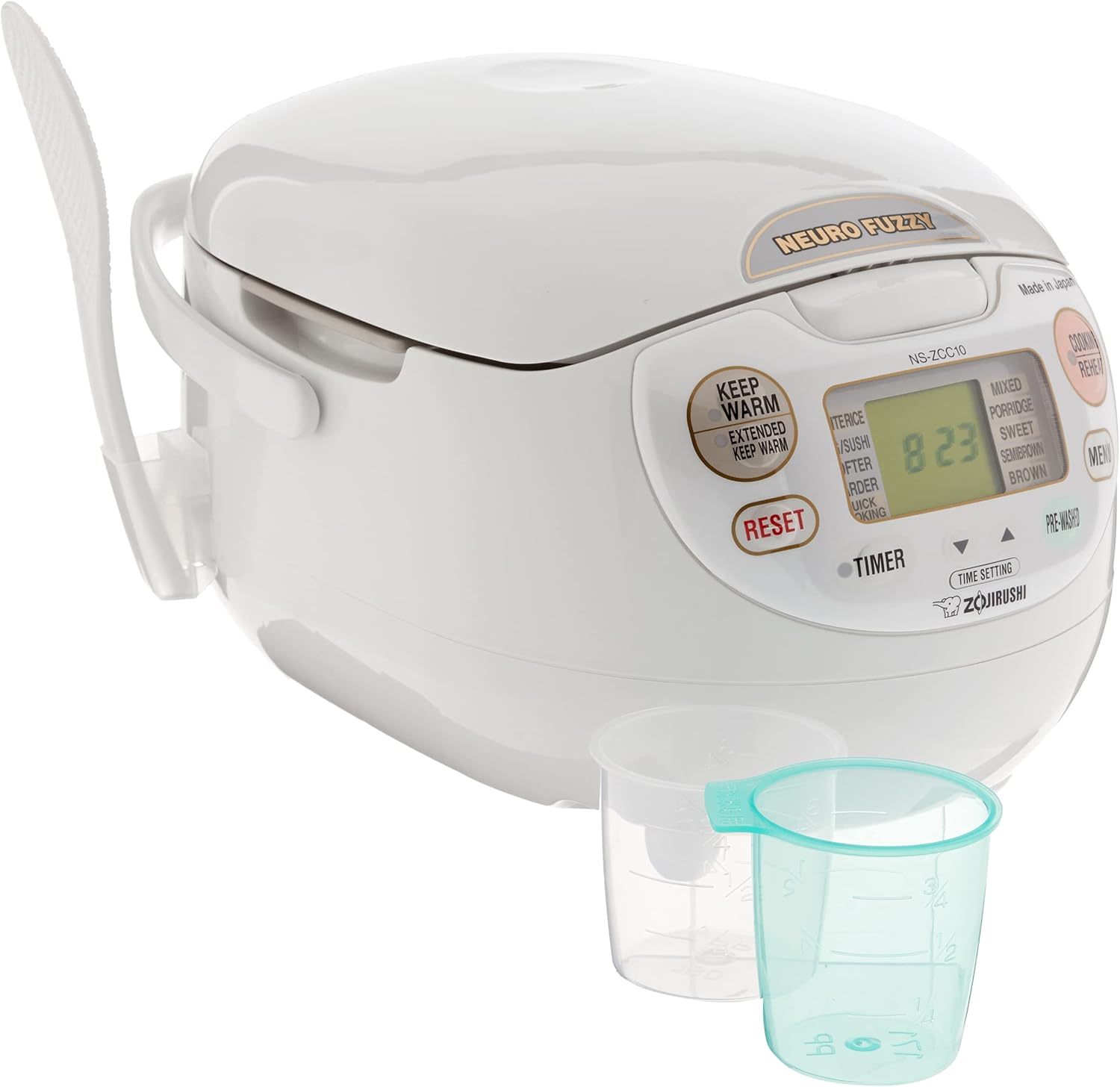
The premium white exterior finish on this particular model offers a clean aesthetic that integrates into most kitchen styles without appearing overly utilitarian or dated. The control interface uses straightforward buttons and a display that shows which cooking mode is active and provides basic status information.
Multiple Cooking Settings
Rather than operating in a single “rice cooker” mode, the NS-ZCC10 offers several different cooking presets designed for various rice types and preparation preferences:
White Rice Mode: Optimized for standard white rice varieties, this setting aims to produce fluffy grains without stickiness or mushiness. The algorithm accounts for how white rice absorbs water and the timing of different cooking phases.
Brown Rice Setting: Brown rice has a tougher outer bran layer than white rice, requiring more liquid and longer cooking time to achieve proper tenderness. A dedicated brown rice mode addresses these differences by extending the cooking duration and managing moisture retention appropriately.
Mixed Rice Option: This setting handles rice blends that combine white and brown grains, adjusting cooking parameters to account for the different cooking times these varieties require.
Sushi Rice Function: Sushi rice requires specific preparation—it needs to be cooked to a particular firmness that differs from everyday white rice. This dedicated setting produces rice with the texture traditionally favored for sushi preparation.
Having multiple settings acknowledges that different rice varieties and culinary applications benefit from different approaches. Rather than forcing all rice into a single cooking profile, the NS-ZCC10 recognizes these distinctions.
Keep Warm and Extended Storage
Beyond the initial cooking phase, the NS-ZCC10 maintains a keep-warm function that activates after cooking completes. This feature holds the rice at a food-safe temperature without continuing to cook it, preventing the bottom layer from becoming hard or overcooked.
The extended keep-warm capability can maintain rice quality for several hours, which proves useful when serving is delayed or when multiple dishes require coordination in meal timing. Most users find that rice quality remains acceptable for approximately four to eight hours in keep-warm mode, though variations in room temperature and how often the lid is opened can affect this timeframe.
Removable Inner Lid
Many rice cookers have inner lids that trap steam during cooking. The NS-ZCC10’s removable inner lid allows easier access to the cooking vessel and simplifies the cleaning process. You can remove it, wash it separately, and ensure no rice residue or mineral buildup accumulates in areas difficult to reach on a fixed lid.
This seemingly small design choice actually affects the user experience significantly. Cleaning is less frustrating, and maintenance is more straightforward than with rice cookers that feature permanently attached inner lids.
How the NS-ZCC10 Can Be Used in Your Kitchen
Everyday Rice Preparation
The most straightforward application involves preparing rice for everyday meals. The basic process is simple: measure rice into the removable vessel, rinse if desired, add appropriate water for the rice type selected, place the vessel in the cooker, select the corresponding rice setting, and let the machine handle the rest.
For many cooks, particularly those in households where rice appears multiple times per week, having a dedicated cooker eliminates the guesswork that comes with stovetop cooking. The consistency means you can plan meals with confidence that rice will be ready at a predictable time and with predictable quality.
Batch Cooking and Meal Preparation
The 5.5-cup capacity makes the NS-ZCC10 suitable for cooking larger portions that provide rice for multiple meals. You might cook a batch on Sunday evening, then portion it into containers for the week’s meals. Cooked rice stores well in the refrigerator and reheats effectively in a microwave or on the stovetop.
This approach to meal planning works particularly well for those following structured eating plans or anyone seeking to simplify weekday cooking by preparing components ahead of time.
Entertaining and Larger Gatherings
While 5.5 cups isn’t massive, it’s sufficient for serving rice to a dinner party of six to eight people as a side dish. If rice is a central element of the meal—such as when serving paella, risotto, or rice-based dishes from various cuisines—you might use the cooker as part of a larger preparation strategy rather than as the sole cooking vessel.
Some cooks also use the cooker for specialty preparations like cooking grains that aren’t technically rice but benefit from similar cooking approaches—certain varieties of quinoa, millet, or other grains can be prepared successfully in rice cookers, though this requires some experimentation with liquid ratios.
Reducing Active Cooking Time
For busy individuals or families, the hands-off cooking nature of rice cookers offers genuine time savings. Rather than staying in the kitchen to monitor a pot, you might prepare other components of your meal—chopping vegetables, preparing proteins, making sauces—while the rice cooks unattended.
This parallel workflow often results in meals coming together more efficiently than sequential cooking methods where each component waits for attention.
Who Might Benefit from This Model
Regular Rice Consumers
Households where rice appears in meals several times per week see the most obvious benefit from owning a dedicated rice cooker. If rice is a dietary staple or central to your family’s food traditions, the consistency and convenience justify the appliance’s space and financial investment.
People Cooking for Multiple People
Preparing rice for families or multiple-person households becomes simpler with a dedicated cooker. The fixed capacity means you know exactly how much rice you’re preparing, and the keep-warm function allows flexibility in timing when serving people at slightly different times.
Those Interested in Different Rice Varieties
If you cook with various rice types—sometimes white rice, other times brown rice or specialty varieties—an appliance with multiple settings accommodates this diversity. Rather than trying to adjust stovetop timing by trial and error for each variety, the multiple presets handle the technical adjustments.
People with Limited Stovetop Space
In kitchens where stovetop burners are already dedicated to other dishes during meal preparation, a rice cooker frees up valuable cooking surface. This is particularly relevant in smaller kitchens, in catering situations, or during holiday cooking when every burner is in use.
Individuals Seeking Consistency
Some people are simply less interested in developing stovetop cooking technique and prefer the reliability of automated appliances. This is a perfectly valid preference, and there’s no benefit to struggling with manual methods if an appliance handles the task competently.
Important Considerations Before Purchase
Understanding Water-to-Rice Ratios
While the NS-ZCC10 simplifies rice cooking considerably, it still requires accurate water measurement. The appropriate water-to-rice ratio varies by rice type and desired firmness. Generally, white rice uses roughly 1.5 to 1.75 parts water to 1 part rice, while brown rice requires closer to 2.5 parts water to 1 part rice. The cooker’s programming accounts for these differences through its multiple settings, but you still need to measure water accurately.
Most rice cookers include a measuring cup specifically designed to work with the volume calculations the cooker expects. Using this cup, rather than standard kitchen measuring cups, ensures consistency.
Kitchen Space and Visibility
Before purchasing any countertop appliance, assess where it will live in your kitchen. The NS-ZCC10 is reasonably compact, but it still occupies space. Some people integrate it into their counter setup permanently, while others store it in cabinets or closets between uses.
Consider visibility from where you typically stand while cooking. If the cooker is tucked away, you might forget to use it regularly or overlook when cooking is complete.
Maintenance Requirements
The removable inner lid and vessel simplify cleaning, but the heating element in the base requires some care. Calcium deposits from minerals in water can accumulate over time, particularly in areas with hard water. Periodic descaling with vinegar or specialized rice cooker cleaning solutions helps maintain performance.
This isn’t particularly onerous—perhaps a descaling every three to six months depending on water hardness—but it’s worth understanding that the appliance requires occasional maintenance beyond simple rinsing.
Rinsing Practices
Traditional rice cooking often includes rinsing uncooked rice before preparation. This removes surface starch and dust that can affect the final texture. The NS-ZCC10 can handle both rinsed and unrinsed rice, though you’ll notice differences in the final texture. Unrinsed rice typically produces slightly stickier results, which some preferences favor and others prefer to avoid.
Elevation Differences
In high-elevation areas, water boils at lower temperatures, affecting cooking times and liquid evaporation rates. Some users report that rice cookers with adaptive programming like the neuro fuzzy system perform more consistently at elevation than basic models, but results may still vary. If you live at significant elevation, testing early batches to assess results is prudent.
General Comparison of Rice Cooker Categories
Basic Models vs. Programmable Systems
At the simplest end of the rice cooker spectrum are basic two-button models: one for cooking, one for warming. These cookers use fixed heating schedules—they heat at a set temperature for a set time, then switch to warm mode. They’re affordable and reliable for standard white rice but don’t adapt to variations in rice type or quality.
Programmable systems like the NS-ZCC10 occupy the middle ground. They offer multiple settings for different rice varieties and use some form of adaptive technology (like neuro fuzzy systems) to monitor cooking and adjust as needed. These cost more than basic models but less than high-end systems.
Premium rice cooker systems exist that add pressure cooking, induction heating, artificial intelligence-based learning, and even smartphone connectivity. These add capabilities and consistency but at substantially higher cost.
The NS-ZCC10 represents a middle-ground approach—more sophisticated than basic two-button cookers but more accessible than premium systems.
Capacity Considerations
Rice cookers range from tiny single-serving models to large capacity cookers holding 10+ cups. The 5.5-cup size of the NS-ZCC10 suits households of three to six people well. Smaller households might find smaller models more appropriate, while larger families or commercial applications might benefit from larger capacity.
The relationship between capacity and cooking quality isn’t perfectly linear—sometimes a too-large cooker with insufficient rice doesn’t cook as effectively as a properly proportioned smaller model. Matching capacity to your typical serving needs is more important than maximizing capacity.
Heat Distribution Technologies
Different brands employ different approaches to heat distribution. Some use basic flat heating plates, others use enhanced systems designed to distribute heat more evenly across the cooking vessel bottom. This affects how hot spots develop and whether certain rice grains overcook while others undercook.
The NS-ZCC10’s nonstick-coated vessel and careful heating design aim for even distribution, though no system is absolutely perfect.
Frequently Asked Questions
How much rice does the 5.5-cup capacity actually cook?
The 5.5-cup measurement refers to uncooked rice volume. When cooked, the same quantity of uncooked rice expands to approximately 15 to 18 cups of cooked rice, depending on the rice type. This translates roughly to 8 to 12 servings, depending on portion size and whether rice is the main dish or a side.
Can I cook other grains besides rice in the NS-ZCC10?
While the cooker is specifically designed for rice, some users successfully prepare other grains with adjusted liquid ratios. Quinoa, millet, and certain other grains can work with experimentation. However, the cooker’s multiple settings are specifically calibrated for rice varieties, so other grains may require manual liquid adjustment through trial and error.
How long does cooking typically take?
White rice usually completes in 25 to 35 minutes, while brown rice typically requires 45 to 60 minutes, depending on the specific variety and water temperature when cooking begins. The cooker’s display shows that cooking is in progress, and most models produce an audible signal when cooking completes.
Is the cooker safe to leave unattended?
Yes. The NS-ZCC10’s automatic shutoff and keep-warm functions mean the cooker safely maintains rice after cooking completes. There’s no risk of it continuing to cook indefinitely or overheating if you forget about it momentarily.
What’s the difference between neuro fuzzy and basic cookers regarding actual results?
The practical difference appears most noticeably when cooking different rice varieties or when water quality varies significantly. Basic cookers produce acceptable results for standard white rice but may struggle with brown rice or specialty varieties. Neuro fuzzy systems adapt more effectively to these variations, producing more consistent results across different situations.
Does the cooker require any special water, or is tap water fine?
Tap water works fine, though very hard water (with high mineral content) can cause mineral buildup over time. In areas with extremely hard water, periodic descaling becomes more frequent, but it remains a manageable maintenance task.
How does the keep-warm function work, and how long can rice stay warm?
The keep-warm function maintains the rice at approximately 165-170°F, a temperature that keeps food at safe serving warmth without continued cooking. Most users find rice quality remains good for 4 to 8 hours, though extended periods may result in some drying at the bottom of the vessel.
Can I open the lid while cooking?
Opening the lid disrupts the cooking process by releasing steam, which can affect the final texture. It’s best to wait until cooking completes before checking the rice. The cooker’s automatic signaling lets you know when cooking is done without needing to peek.
Is the inner coating on the pan durable?
Nonstick coatings on rice cooker pans are generally durable when used as intended. Avoiding abrasive scrubbing and metal utensils helps preserve the coating. Over years of regular use, some degradation may occur, but this is normal wear rather than a defect.
What accessories come with the NS-ZCC10?
Typically, Zojirushi rice cookers include the measuring cup specifically calibrated for the cooker, a rice spatula designed for nonstick surfaces, and possibly a steaming basket for cooking vegetables alongside rice. Checking the specific package contents ensures you have what’s needed for basic use.
Conclusion
The Zojirushi NS-ZCC10 represents a practical middle-ground option in the rice cooker market. It offers sufficient capacity for typical household meals, incorporates adaptive cooking technology designed to handle different rice varieties, and maintains a form factor that fits reasonably into most kitchens.
The transition from stovetop rice cooking to using a dedicated cooker involves trade-offs. You gain consistency, convenience, and the ability to prepare rice hands-off, while trading some kitchen space and the need for occasional maintenance. For anyone regularly cooking rice, these trade-offs generally prove worthwhile.
Whether the NS-ZCC10 specifically suits your situation depends on your household size, how frequently you cook rice, which varieties you prepare, and your preferences regarding kitchen tool investment. There are adequate alternatives at lower price points and more sophisticated options at higher ones, but this model occupies a sensible middle position with thoughtful feature selection.
Understanding how automated rice cooking technology works, what different settings accomplish, and how the specific design of any cooker affects results helps transform rice cooking from something that requires constant technique refinement into something that simply produces reliable results with minimal effort.